



| In amyotrophic lateral sclerosis (ALS), symptoms and support needs can change over time. That is why it is important to identify necessary medications, assistive devices, or additional treatments as early as possible. The ALS app from APST supports you with personalized care recommendations. |
| How are the dietary recommendations developed? The care recommendations are based on your regular ALSFRS-R self-assessment in the ALS app. The ALS Functional Rating Scale (ALSFRS-R) consists of twelve questions about important functions such as speaking, swallowing, hand and arm function, walking, climbing stairs, and breathing. Your answers will be evaluated using a care algorithm developed by ALS experts at Charité – Universitätsmedizin Berlin. If the algorithm identifies a potential need for care based on the information you provide, the ALS app can display a suitable care recommendation. What recommendations can I get? Based on the information you provide, recommendations may be generated for the following areas of care, for example: – Medications, for example, for speech disorders or excessive salivation – Modified forms of riluzole and liquid nutritional supplements for swallowing difficulties – Movement trainers or arm support systems for declining arm strength – Communication aids for increasing speech impairments – Wheelchairs and other mobility aids for walking difficulties – Additional recommendations for nutritional or respiratory therapy The recommendation that appears depends on your personal situation and your answers in the ALSFRS-R. |
| Where can I find my dietary recommendations? You can find your personalized care recommendations in the ALS app under “Recommendations.” There, you can view the individual recommendations and get more information about the suggested care. |
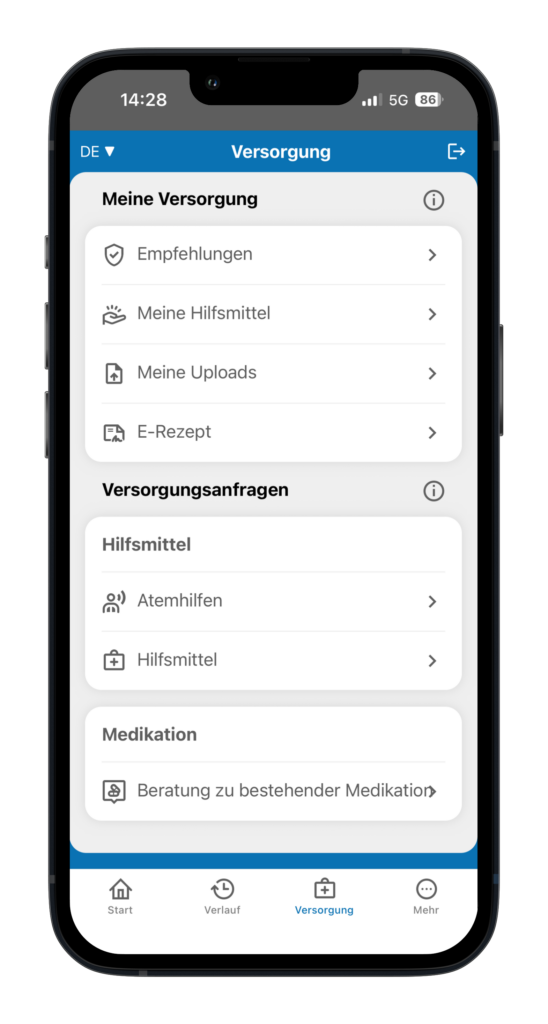
In the “My Care” section, you ‘ll find your personalized care recommendations as well as other important features related to your care.
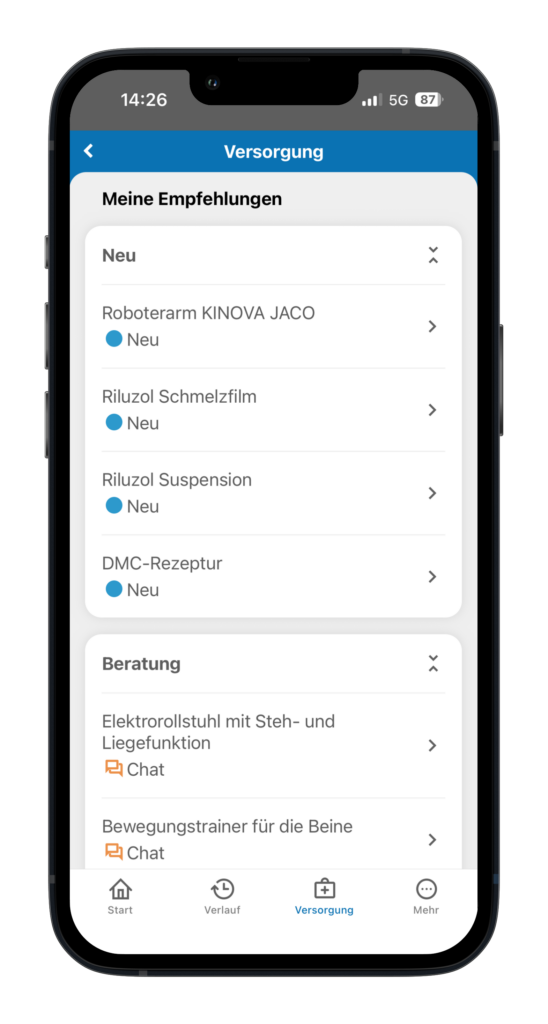
New care recommendations are clearly displayed in the “My Recommendations > New” section. You can open each recommendation individually to learn more about why the care might be relevant to you and what next steps you can take.
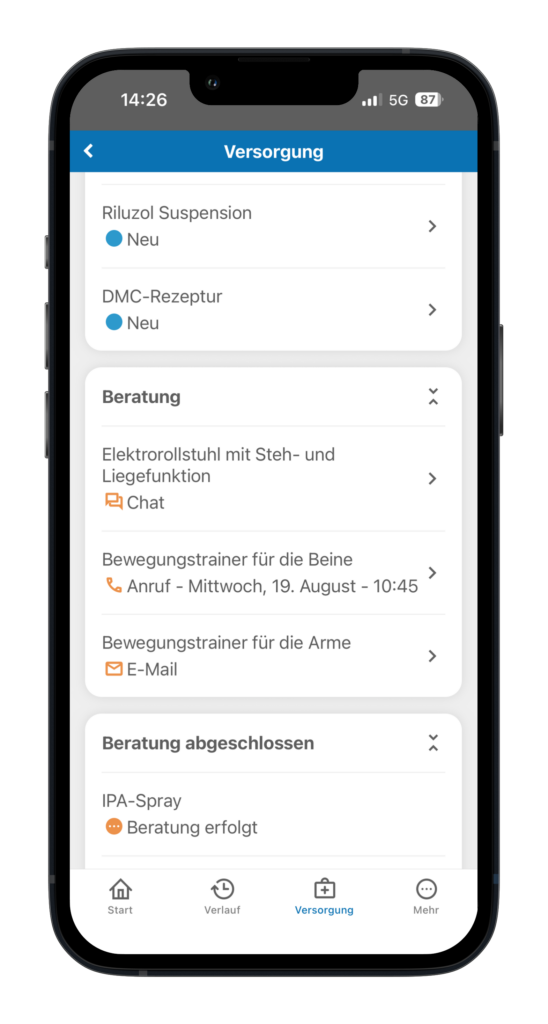
If you’d like to receive guidance regarding a recommendation, the current guidance process will be displayed directly in the app. Depending on the recommendation, guidance may be provided via chat, phone, or email, for example. This way, you can keep track of the status of your request at all times.
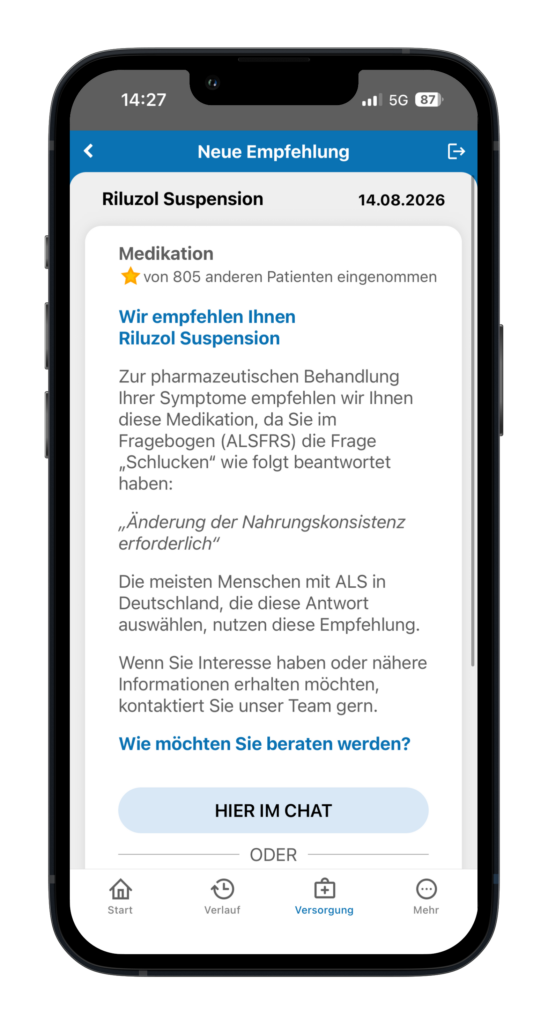
You will receive a brief explanation for each new care recommendation. The ALS app explains why the recommendation may be relevant to you —for example, based on the information you provided in the ALSFRS questionnaire—and informs you about the recommended care.
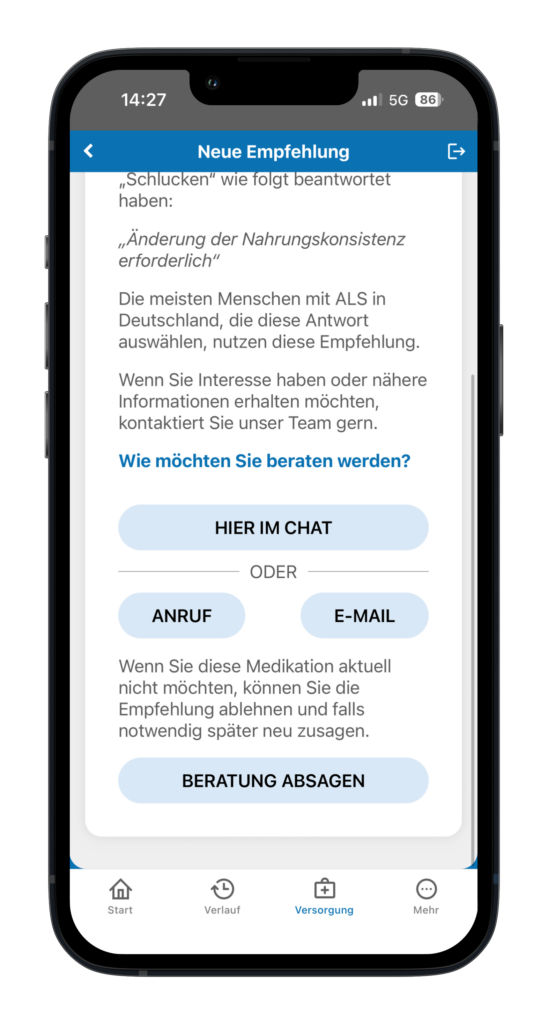
You decide for yourself how you’d like to receive advice on a care recommendation. Depending on the service , you can request a consultation directly via chat, by phone, or by email . If you don’t want to use a recommendation right now, you can also decline it and come back to it later.
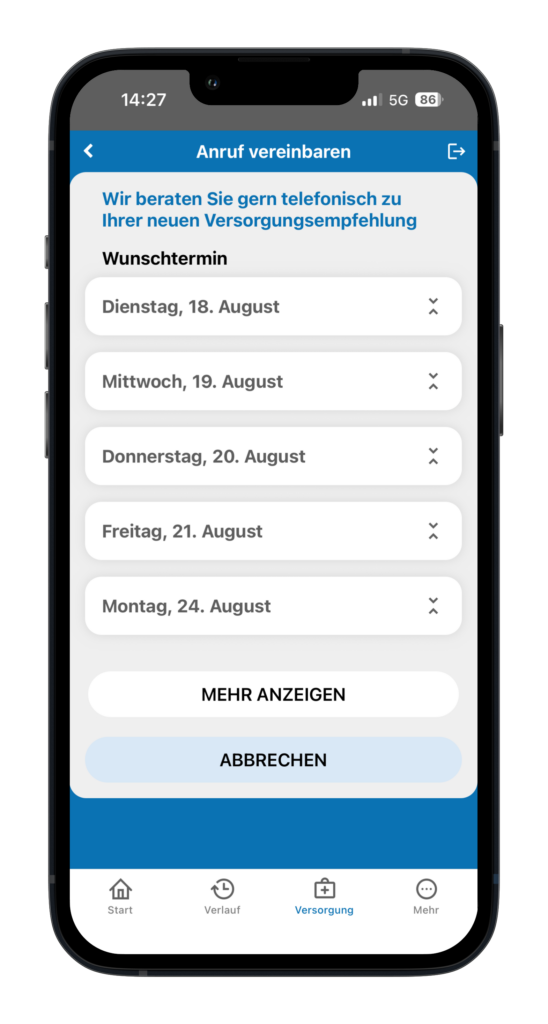
For example, if you would like a consultation over the phone, you can select a convenient appointment time directly in the ALS app. The care team will then contact you at the agreed-upon time to discuss the recommendation in person.
| From Recommendation to Actual Care A care recommendation does not mean that a medication or assistive device will automatically be prescribed. It is, first and foremost, a suggestion for a course of treatment that may be appropriate. If you would like to receive a medical device, the recommendation from APST will be reviewed and discussed with you. In the case of a assistive device, a suitable provider can then be involved. If necessary, a trial period will be arranged. The medical necessity and the prescription will be coordinated with your treating physician or the ALS outpatient clinic. The doctor’s decision is always the deciding factor. The care algorithm is not intended to replace a physician’s assessment, but rather to help identify potential care needs at an early stage. With these care recommendations, we aim to help ensure that changes in care needs associated with ALS are identified as early as possible and that the appropriate care can be determined in collaboration with you and your treating physicians. Best regards, Your APST Team |